Showing posts with label UNITED ARAB REPUBLIC (UAR). Show all posts

02/08/2021

UNITED ARAB REPUBLIC (UAR) - Egypt


UNITED ARAB REPUBLIC (UAR) - Egypt.

Definitive stamps.
Sadd el-Ali Dam in the Nile River, Aswan.
Fifth stamp in a set of 12, issued on 01.01.1964.
Face value: 5 milliemes of Egyptian pound.
Printing: Photogravure.
Size: 30 x 25 mm.

Catalogs
- Michel No. 721b.
- Scott No. 604a,
- StampWorld No. 193.
- Stanley Gibbons No. 773.
- Yvert et Tellier No. 582.

The Aswan Dam, or more specifically since the 1960s, the Aswan High Dam, is the largest embankment dam in the world, which was built on the course of the Nile River in Aswan Governorate. It was built between 1960 and 1970. The dam became a key government target after the Egyptian Revolution of 1952 and has had a significant effect on Egypt's economy and culture. The dimensions of the work are: 111 m (364 ft) high, 3,830 m (12,570 ft) long, and 980 m (3,220 ft) wide at the base. The reservoir, called Lake Nasser, is 500 km (310 miles) long and 35 km (22 miles) at its widest, covering an area of 5,250 km2 (2,030 square miles). A part of the lake is located on the territory of Sudan, where it is called Lake Nubia. Lake Nasser flooded much of lower Nubia and between 100,000 and 120,000 people were resettled in Sudan and Egypt. 22 monuments and architectural complexes that were threatened by the lake, including the temples of Abu Simbel, were preserved by moving them to the banks as part of the UNESCO Nubia Campaign. The Egyptian countryside benefited from the Dam through improved irrigation and electrification. The Aswan Dam was designed by the Moscow-based Hydroproject Institute.

12/03/2021

UNITED ARAB REPUBLIC (UAR) - Egypt


UNITED ARAB REPUBLIC (UAR) - Egypt.

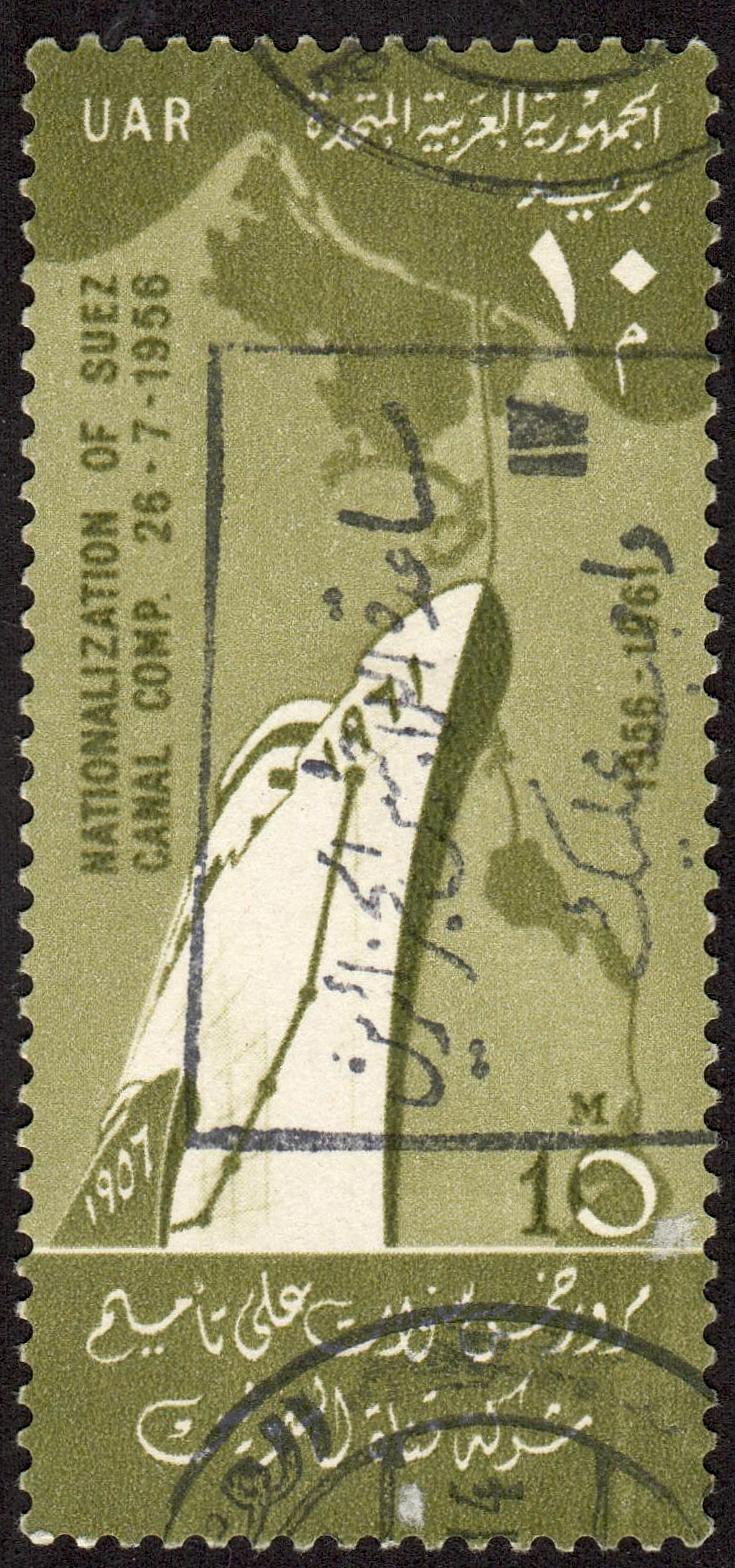
5th anniversary of the nationalization of the Suez Canal Company.
Stylized map of the Suez Canal and ship.
Stamp issued on 26.07.1961.
Face value: 10 milliemes of Egyptian pound.
Printing: Photogravure.
Size: 26 x 60 mm.

Catalogues
- Michel No. 634 (Egypt).
- Scott No. 529 (Egypt).
- StampWorld No. 106 (UAR).
- Stanley Gibbons No. 666 (Egypt).
- Yvert et Tellier No. 505 (Egypt).

The Suez Canal (in Arabic, قناة السويس) is a navigable canal located in Egypt that connects the Mediterranean Sea with the Red Sea. Its length is 163,30 km (120.11 mi) between Port Saíd (on the Mediterranean coast) and Suez (on the Red Sea coast). The canal excavation works began officially on April 10, 1859, promoted by the French Ferdinand de Lesseps. It was solemnly inaugurated on November 17, 1869, although the first ship had crossed it on February 17, 1867.
On July 26, 1956, Egyptian President Gamal Abdel Nasser decided to nationalize the canal to finance the construction of the Aswan Dam. The measure was received with indignation by France and the United Kingdom, the main shareholders of the Suez Canal, and on October 29 of that same year the so-called Sinai War broke out. Egypt, in retaliation, sank forty ships in the canal, causing its blockade. At the beginning of 1957, after the intervention of the UN, the withdrawal of the European powers and Israel was completed and the canal could be reopened.

21/01/2021

UNITED ARAB REPUBLIC (UAR) - Egypt


UNITED ARAB REPUBLIC - Egypt.

New planes for United Arab Airlines.
Air routes map from Cairo, and Ilyushin 18 plane.
Airmail stamp issued on 02.03.1969.
Face value: 55 milliemes of Egyptian pound.
Printing: Photogravure.

Catalogues
- Michel No. 909.
- Scott No. C122.
- StampWorld No. 382.
- Stanley Gibbons No. 976.
- Yvert et Tellier No. PA 113.

In January 1961 Misr Air merged with Syrian Airways to form United Arab Airlines (UAA) as a result of the new political relations between Egypt and Syria, although this agreement was short-lived. It retained its name for a time, but was eventually replaced by Egyptair in October 1971.

05/01/2021

UNITED ARAB REPUBLIC (UAR) - Egypt


UNITED ARAB REPUBLIC (UAR) - Egypt.

14th Anniversary of Revolution of 23 July 1952. Development of Sinai.
Illustrated map on Sinai Peninsula.
Last stamp in a set of 4, issued on 23.07.1966.
Face value: 10 milliemes of Egyptian pound.
Stamping: Photogravure.
Size: 40 x 40 mm.

Catalogues
- Michel No. 830.
- Scott No. 700. (701?)
- StampWorld No. 305.
- Stanley Gibbons No. 888.
- Yvert et Tellier No. 681.

The Sinai Peninsula (in Arabic, شبه جزيرة سيناء; in Hebrew, חצי האי סיני), northeast of Egypt, between the Mediterranean Sea and the Red Sea, bordering Israel and Palestine (Gaza Strip) to the east, has a surface area of 61,000 km2 (23,550 sq mi) and is desert in most of its territory. Inhabited since prehistoric times, it served for centuries as a trade route between North Africa and the Near East. Occupied by the Byzantine Empire and later by the Ottoman Empire, the peninsula was administered by Egypt from 1949 until Israel invaded it militarily, which led to the Six Day War in June 1967. From 1949 to 1973 Sinai was the scene of bitter fighting in 1956, 1967 and 1973. Following the peace agreement reached between Egypt and Israel in 1979, the peninsula was returned to Egypt and demilitarized under the terms of the agreement. The situation in the territory, however, remained unstable.

10/12/2020

UNITED ARAB REPUBLIC (UAR) - Egypt


UNITED ARAB REPUBLIC (UAR) - Egypt.

The Suez Canal Long Distance Swimming Championship (1963).
Stylized map of the Suez Canal.
Stamp issued on 15.10.1963.
Face value: 10 milliemes of Egyptian pound.

Catalogues
- Michel No. 179.
- StampWorld No. 179.
- Yvert et Tellier No. 568.

The Suez Canal (in Arabic, قناة السويس) is a navigable canal located in Egypt that connects the Mediterranean Sea with the Red Sea. Its length is 163,30 km (120.11 mi) between Port Saíd (on the Mediterranean coast) and Suez (on the Red Sea coast). The canal excavation works began officially on April 10, 1859, promoted by the French Ferdinand de Lesseps. It was solemnly inaugurated on November 17, 1869, although the first ship had crossed it on February 17, 1867.