Showing posts with label ROMANIA. Show all posts

07/03/2022

ROMANIA


ROMANIA / ROMÂNIA.

Definitive stamps. Buildings.
Vidraru Dam, Argeș.
Fifth stamp in a set of 19, issued on 15.10.1972.
Face value: 5.15 Romanian lei.
Design: Ion Dumitrana (1923-1976) & Aida Tasgian- Constantinescu.
Printing: Photogravure.
Size: 28 x 22 mm.

Catalogs
- Michel No. 3087.
- Romfilatelia No. 804d.
- Scott No. 2357.
- StampWorld No. 3046.
- Stanley Gibbons No. 3933.
- Yvert et Tellier No. 2779.

The Vidraru Dam was built between 1960 and 1966 in the course of the Argeș River, in northern Argeș County, for the production of electricity, irrigation and flood prevention. The dam’s height is 166 m (545 ft), the arch length 305 m (1,000 ft) and it can store 465 million m3 of water. The reservoir is 8.94 km2 (3.45 sq mi), its length is 10.3 km (6.4 mi), the maximum width is 2.2 km (1.4 mi) and its circumference is 28 km (17 mi). The Vidraru Hydro Power Plant has an installed capacity of 220 MW.

06/01/2022

ROMANIA


ROMANIA / ROMÂNIA.

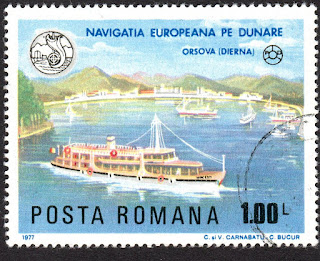
European navigation on the Danube.
"Mirceşti" ship at Orşova.
Face value: 1 Romanian leu.
Design: C. & V. Carnabatu - C. Bucur.
Printing: Photogravure.
Print: 3,000,000 copies.
Size: 55 x 42.5 mm.

Catalogs
- Michel No. 3485.
- Scott No. 2738.
- StampWorld No. 3474.
- Stanley Gibbons No. 4347.
- Yvert et Tellier No. 3079.

Orşova is a municipality in Mehedinți County, Banat. It is located on the banks of the Iron Gates I reservoir on the Danube, at the mouth of the Cerna River. In the 2011 census, its population was 10,441 inhabitants. As a result of the construction of the reservoir, the city was flooded in 1970, and the population was relocated to a completely new city built between 1966 and 1971 on the southern slopes of the Almăj Mountains. In the 2nd century AD the Romans built the Dierna fort there.

18/10/2021

MOLDOVA


MOLDOVA

Issue EUROPA C.E.P.T. 2020: Ancient Postal Routes.
Map of the first postal air routes, 1926.
Second stamp in a sef of 2, issued on 17.08.2020.
Face value: 11 Moldovan lei.
Design: Vitaly Pogolsha.
Printing: Offset lithography.
Print: 4,000 copies.

Catalogs
- Michel No. 1131.
- Scott No. 1063.
- StampWorld No. 1137.
- Yvert et Tellier No. 989.

The first flights to Chişinău began on June 24, 1926, on the Bucharest - Galaţi - Chişinău route. The flights were operated by the Compagnie Franco-Roumaine de Navigation Aérienne. From Bucharest via Galaţi a flight was also established to Iași. These first flights were used to transport postal mail.

29/07/2021

ROMANIA


ROMANIA / ROMÂNIA.

Danube bridges,
Anghel Saligny Bridge, Cernavodă.
First stamp in a set of 3, issued on 25.06.1972.
Face value: 1.35 Romanian leu.
Design: Vlasto Stoianov.
Printing: Photogravure.
Print: 4,000,000 copies.
Size: 55 x 34 mm.

Catalogs
- AFA No. 3001.
- Michel No. 3031.
- Fomfilatelia No. 795a.
- Scott No. 2337.
- StampWorld No. 3020.
- Stanley Gibbons No. 3910.
- Yvert et Tellier No. 2694.

The Anghel Saligny Bridge (formerly King Carol I Bridge) is a railroad truss bridge in Romania, across the Danube River, connecting the regions of Muntenia and Dobruja. The bridge, built between 1890 and 1895, is listed in the National Register of Historic Monuments. When it was completed, with a total length (with viaducts) of 4,087.95 m (13,411.9 ft), it became the longest bridge in Europe and the second longest in the world. The bridge was designed by the Romanian engineer Anghel Saligny. The two cities on the banks of the river which was built were Feteşti on the left side and Cernavodă on the right side. The entire bridge was inaugurated on September 26, 1895, and as a test on the opening, a convoy of 15 whistling locomotives sped at 60 km/h, followed by a train reserved for guests, at 80 km/h.

14/07/2021

ROMANIA


ROMANIA / ROMÂNIA.

Hidroelectric Power Plants and Dams.
Piatra Neamț Dam.
Third stamp in a set of 6, issued on 10.03.1978.
Face value: 55 Romanian ban.
Design: Vlasto Stoianov.
Printing: Photogravure.
Print: 2,000,000 copies.
Size: 49 x 34 mm.

Catalogs
- Michel No. 3495.
- Scott No. 2757.
- StampWorld No. 3484.
- Stanley Gibbons No. 4359.
- Yvert et Tellier No. 3090.

Piatra Neamț power plant has 2 turbines type KVB 5.5-15, a flow installed in the plant of 84 m³ / s, with an energy production of 52 GWh. It is supplied by the Bâtca Doamnei accumulation lake, in the course of the Bistrita River, and is situated at an altitude of 326 m (1,070 ft) above sea level. It has an area of 2.35 km2 (0.87 sq mi), a length of 3.2 km (1.99 mi), and a maximum width of 1,050 km (0.93 mi); its maximum depth is 15.5 m (51 ft). This artificial lake was formed in 1963 by the construction of the Piatra Neamț dam (on the stamp), with a total length of 800 m (2,625 ft) and a height of 27 m (88.6 ft).

25/05/2021

YUGOSLAVIA (Serbia)


YUGOSLAVIA (Serbia) / ЈУГОСЛАВИЈА (Србија - Srbija).

Airmail definitive stamps.
Danube River at the Iron Gates.
First stamp in a set of 9, issued on 16.06.1951.
Face value: 1 Yugoslav dinar.
Design: Janez Trpin (1908-1973).
Engraving: Kocmut.
Printing: Recess.
Size: 39 x 24 mm.

Catalogs
- AFA No. 635.
- Michel No. 644A.
- Scott No. C34.
- StampWorld No. 676.
- Stanley Gibbons No. 675.
- Yvert et Tellier No. PA 32.

The Iron Gates (Serbian: Ђердапска клисура / Đerdapska klisura; Romanian: Porțile de Fier) is a gorge on the river Danube. It forms part of the boundary between Serbia (to the south) and Romania (north). In the broad sense it encompasses a route of 134 km (83 mi); in the narrow sense it only encompasses the last barrier on this route, just beyond the Romanian city of Orșova, that currently contains two hydroelectric dams, with two power stations. At this point in the Danube, the river separates the southern Carpathian Mountains from the northwestern foothills of the Balkan Mountains. The Romanian side of the gorge constitutes the Iron Gates Natural Park (Parcul Natural Porțile de Fier), whereas the Serbian part constitutes the Đerdap National Park (Национални парк Ђердап / Nacionalni park Đerdap). A wider protected area on the Serbian side was declared the UNESCO global geopark in July 2020.

-
Thanks to Dragan Buškulić for his contribution (https://worldofstamp2.wordpress.com/).

16/02/2021

ROMANIA


ROMANIA / ROMÂNIA.

Definitive stamps.
Map of Romania with telephone network.
Fifteenth stamp in a set of 18, issued on 20.12.1967.
Face value: 3 Romanian lei.
Design: J. Drugă.
Printing: Photogravure.
Size: 28 x 33 mm.

Catalogues
- Michel No. 2653.
- Romfilatelia No. 662o.
- Scott No. 1984.
- StampWorld No. 2640.
- Stanley Gibbons No. 3525.
- Yvert et Tellier No. 2366.

Origins of the telephone system in Romania. Telephone arrived in the present Romanian territory at Temesvár (now Timișoara, in Hungarian Transylvania) in 1881, while Bucharest, which acquired a telephone exchange for government use in 1889 (made available to the public the following year), became part of an inter-urban system linked with Brăila and Galaţi in 1890 (with public use following in 1893). Meanwhile in 1890 railway engineers A. Cottescu and M. H. Romniceanu installed a central control system (‘aparat cu telecomandă centralizată’) at Buftea. Bucharest to Ploiești and Sinaia was another early inter-urban telephone link before the rail-based system was extended nationally and internationally to reach Budapest via both the present Brașov-Cluj-Oradea and Craiova-Orșova-Szeged, as well as Vienna via Burdujeni (Suceava). The service was a state monopoly, projected from a great headquarters building in Bucharest in 1899. After the First World War, the achievement of national unity created a greatly enlarged system which in 1926 comprised some 18,400 km of telegraph / telephone lines. In 1965 was created a ministry dedicated to post and telecommunications.

15/01/2021

ROMANIA


ROMANIA / ROMÂNIA.

Tourist promotion.
Babele rock formations in the Bucegi Mountains, Central Romania.
Second stamp in a set of 6, issued on 16.04.1971.
Face value: 40 Romanian bani.
Design: Vlasto Stoianov.
Print: 4,000,000 copies.

Catalogues
- Michel No. 2922.
- Scott No. 2236.
- StampWorld No. 2925.
- Stanley Gibbons No. 3800.
- Yvert et Tellier No. 2597.

Babele (which means "The old women") is the name of an area on the Bucegi Mountains plateau in Romania, within the South Carpathians. The name comes from some mushroom-shaped rock formations, the result of erosion and variable hardness of the rock layers. Some researchers estimate that the shaping agents were water and wind supported by frost and thaw. The alternation of rocks, sandstones and limestones on the plateau is also taken into account. However, human intervention in finishing in more or less regular ways cannot be denied. So far, no scientific evidence has been able to fully explain this phenomenon, and therefore the legends about these rocks are still developing.

05/01/2021

ROMANIA


ROMANIA / ROMÂNIA.

Hydroelectric Power Plants and Dams.
Lake Vidraru and Vidraru Dam.
Fifth stamp in a set of 6, issued on 10.03.1978.
Face value: 2.15 Romanian lei.
Design: Vlasto Stoianov.
Print: 1,000,000 copies.
Printing: Photogravure.
Size: 49 x 34 mm.

Catalogues
- Michel No. 3497.
- Scott No. 2760. (?)
- StampWorld No. 3486.
- Stanley Gibbons No. 3261.
- Yvert et Tellier No. 3093.

Lake Vidraru is an artificial lake created in 1965 in the course of the Argeș River by the Vidraru Dam, in Argeș County, for the production of electricity, irrigation and flood prevention. It is located between the Frunții Mountains and the Ghițu Massif, in the southern Carpathians, and collects the waters of several minor tributaries. The total area of the lake is 8.94 km2 (3.45 sq mi), its length is 10.3 km (6.4 mi), the maximum width is 2.2 km (1.4 mi) and its circumference is 28 km (17 mi). Maximum water depth is 155 m (509 ft) near the 166 m (544.6 ft) high curved dam. The volume of water is 465 million cubic meters. Construction of the dam took five and a half years starting in 1960.

20/12/2020

ROMANIA


ROMANIA / ROMÂNIA.

Tourism promotion.
Bicaz (or Izvorul Muntelui) Lake, and Ceahlău Mount.
Fourth stamp in a set of 5, issued on 29.06.1964.
Face value: 1.25 Romanian lei.
Design: A. L. Ionescu and I. Mihăescu.
Printing: Recess.
Print: 500,000 copies.

Catalogues
- Michel No. 2297.
- Scott No. 1652.
- StampWorld No. 2294.
- Yvert et Tellier No. 2016.

Lake Bicaz, also known as Izvorul Muntelui, is a 32 km2 (12 sq mi) navigable man-made reservoir created by a dam built on the Bistrița River between 1950 and 1960 to generate power at the Bicaz-Stejaru hydroelectric plant. Its maximum depth is 97 m (318 ft). In Potoci, a few kilometers north of the city of Bicaz, there is a biological research facility, equipped with a small submersible used for underwater exploration.

Mount Ceahlău, in the Bistriţa mountain range, division of the Eastern Carpathians, in Neamţ County, has an altitude of 1907 m (6,257 ft). It is integrated into the Ceahlău National Park and has ski slopes.

12/12/2020

ROMANIA


ROMANIA / ROMÂNIA.

Tourist promotion.
Bicaz Gorge (Cheile Bicazului), in the Cheile Bicazului-Hășmaș National Park, 
in Neamţ and Harghita provinces (north-east of Romania).
First stamp in a set of 6, issued on 16.04.1971.
Face value: 10 Romanian bani.
Design: Vlasto Stoianov.
Print: 4,000,000 copies.

Catalogues
- Scott No. 2235.
- StampWorld No. 2924.
- Stanley Gibbons No. 3799.
- Yvert et Tellier No. 2596.

The Bicaz Gorge is located in the Hășmaș mountain range, on the border of the Neamț and Harghita provinces. The canyon was formed by the Bicaz River, and is a natural gate of obligatory passage between the regions of Moldova and Transylvania. It is located in the Bicaz-Hășmaș National Park (Parcul Național Cheile Bicazului-Hășmaș). This area is part of the great chain of the Carpathian Mountains. A spectacular road runs along the gorge, for about 8 kilometers, between steep slopes and winding curves. It can also be traveled by rail, on the route that runs between Bicaz and Gheorgheni. The national park covers an area of 6,575 hectares (65,750,000 square meter) and is divided into two zones: the special conservation zone (78%), and the protection zone (22%).